
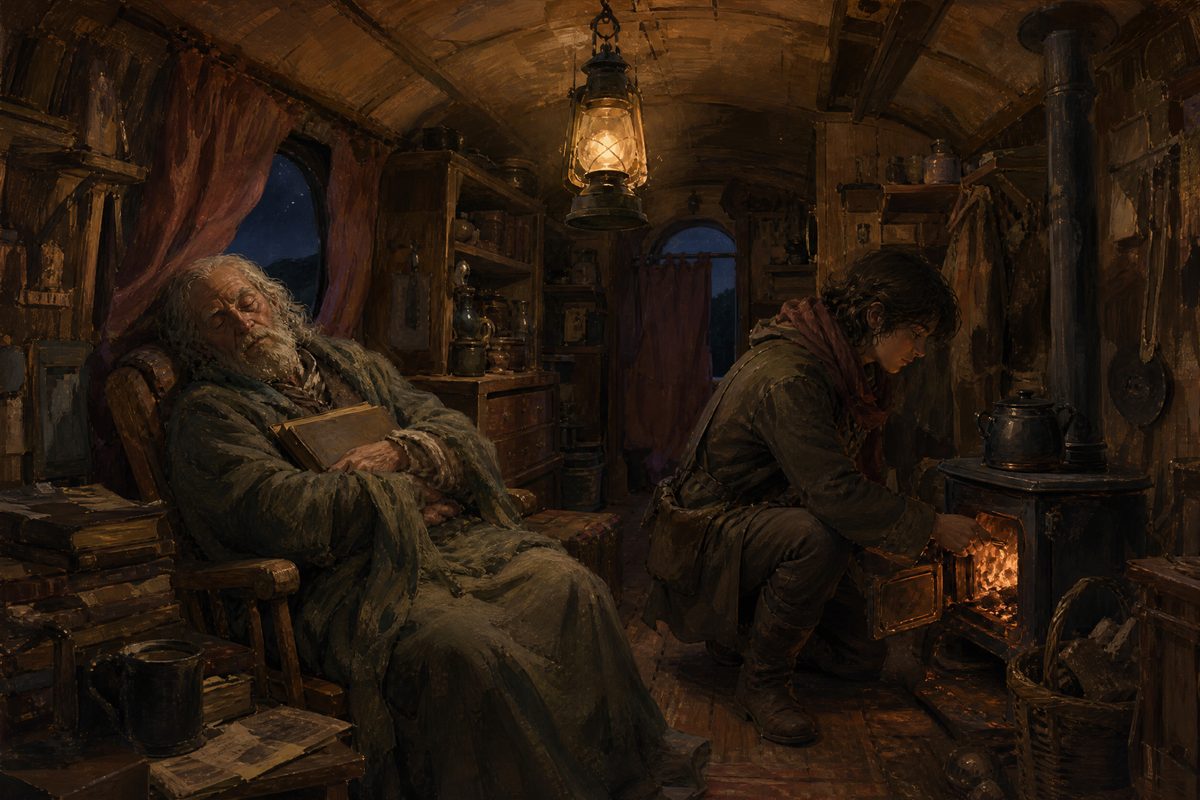
The caravan is the hub. You return to it between journeys, you sell what you found, you re-provision, and you leave. Three companions live in it. Two of them are awake and useful and will talk to you at length about the region and the weather and their opinion of the road.
The third is asleep in a chair by the stove. Every time. In thirty-four hours I never once found him awake, and the game never explains it, never comments on it, and never makes it a quest.
The chore
The stove goes down while he sleeps. If you enter late and leave without touching it, the next time you return the caravan interior is noticeably colder — a blue shift in the lighting, breath visible, and he has pulled the shawl further up. If you bank the stove before you leave, none of that happens.
There is no prompt for this. There is an interactable stove, as there are interactable objects everywhere in this game, and banking it is one of its options alongside cooking and boiling water. Nothing tells you it matters. No dialogue thanks you. No meter moves.
| If you bank the stove | If you do not |
|---|---|
| Warm lighting on return | Cold blue shift |
| Shawl at the shoulders | Shawl pulled to the chin |
| Book still across the chest | Book fallen to the floor |
| No dialogue change | No dialogue change |
I did it every time for about twenty hours before I consciously registered that I was doing it. That is the detail I find most interesting about the whole game, and the reason this essay closes the volume.
Why the name went
Here is the problem this essay had to solve. Volume four's argument is that habit outlasts function, and by that argument this companion should have been recalled in full. He has a habit. He has a very good one. Three readers retained it precisely.
And all three lost the name. Which means habit alone is not sufficient, and something else was missing here that the woman on the ridge path had.
What she had, and he does not, is address. She looks at you. The pause on the ridge is a behaviour aimed at the player. He is asleep. His habit is entirely inward — a thing he does, not a thing he does towards you — and the chore that connects us is one I perform on him while he is unconscious.
A habit that never turns to face you produces a memory with no name attached to it.
The revised formulation
Taking this volume together, the claim we would now defend is narrower than the one we started with. It has two clauses rather than one.
- Behaviour repeated without progression outlasts scripted scenes, however expensive the scenes are.
- Behaviour directed at the player carries identity. Behaviour merely observed carries atmosphere.
The machine in essay three satisfies both: it waits at doorways for you specifically. The animal in essay five satisfies both: it lies against your leg. The four at the table in essay four satisfy both, because the argument is conducted in front of you and each of them appeals to you in turn without ever asking you to decide.
The sleeping scholar satisfies only the first, and produced exactly the outcome the first clause predicts on its own: a vivid, nameless, atmospheric memory that all three of us hold and none of us can attach a person to.
What that means for the volume
Fourteen of thirty-one names survived. Eleven of those fourteen had a habit directed at the player. Of the seven partial recalls, five had habits that were purely observed — cooking, mending, sleeping, reading, staring out of windows — and those five produced, in every case, a scene without a person in it.
It is not a large sample and I would not want it quoted as a law. But it held across nine games and thirty-one companions, and it explains the one result in this volume that our original argument could not.
Closing the volume
Somebody has to bank the stove. It is the most affecting thing in a thirty-four hour game and it involves a sleeping man whose name I never learned well enough to keep.
A year from now we will do this again with nine more games, and the two-clause version will get its proper test. If it holds, the practical advice it implies is almost embarrassingly small: give the character something they do repeatedly, and once in a while have them do it in your direction. Volume five begins in the spring.