
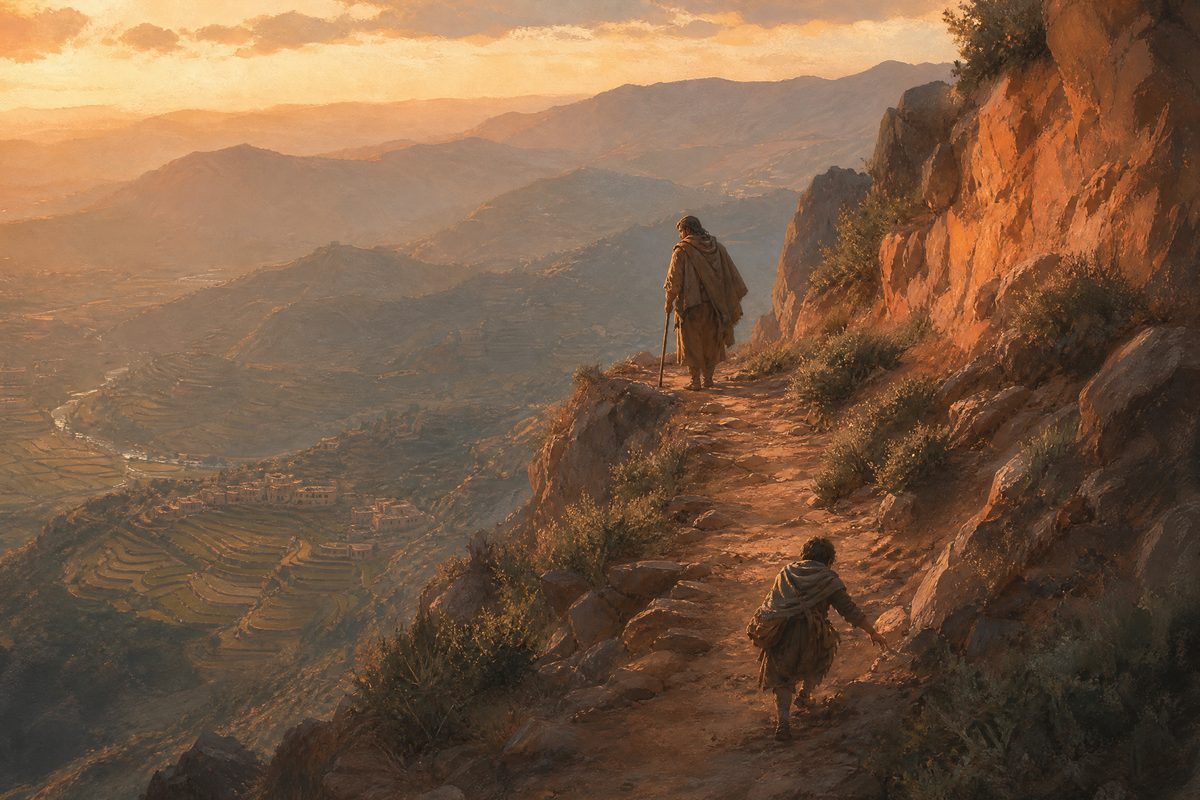
A year is long enough for a game to become almost nothing. I could not tell you now who the antagonist of this one was, what the central conflict concerned, or how it ended, and I finished it. What I can tell you, without hesitating, is that on any climb longer than about twenty seconds she would reach the top first, turn about forty degrees back towards the path, and wait.
Not in a cutscene. Not with dialogue. Not as part of a quest. She would simply be up there, half-turned, in a posture that read as patient rather than impatient, and the game would hold that until I arrived.
What it probably was
I have no illusions about the engineering. Almost certainly a companion follow system with a leash distance, a terrain check that classifies a slope above some gradient as a climb, and one idle animation authored specifically for the top of one. Perhaps a hundred lines of code and a week of an animator's time.
That is not a diminishment. It is the whole argument. A hundred lines of code produced the single most durable memory from a forty-one hour game, outlasting an enormous quantity of writing, voice acting and scripted spectacle that I cannot now recall at all.
| Element | Recalled at 12 months | Estimated production cost |
|---|---|---|
| The pause on the ridge | Complete, with count | Very low |
| Her name | Correct | Negligible |
| Two roadside conversations | Gist only | Moderate |
| The central conflict | Absent | Very high |
| The final sequence | Absent | Very high |
Why a habit beats a scene
A scene happens once. However well written it is, it enters memory as an event, and events decay. A habit happens repeatedly in circumstances you chose, which means every instance is attached to something you were doing rather than something you were shown.
The eleven pauses I remember are not eleven identical moments. One was in rain. One was after I had taken a stupid route up a scree slope and she had waited a long time. One was at the top of a col with the valley opening out behind her, and I stood still for a while before continuing because the composition was good and she was in it.
The scenes were made for me. The pauses happened because of where I went, which is why they are mine.
This is the pattern that runs through the whole volume. Fourteen of thirty-one companions survived the year, and eleven of those fourteen had a habit of some kind. The animal that sleeps on your boot has one. The machine with no dialogue at all is made almost entirely of them.
The error of one
My memory said eleven. The notes said twelve. I find the missing one interesting rather than embarrassing, because of which one it was.
According to the notes, the twelfth pause happened during a scripted sequence, on a slope I was crossing under time pressure while she said something plot-relevant. It is the only one of the twelve that was authored as part of a scene rather than emerging from movement, and it is the only one that did not survive.
I would not build a theory on a single data point, but it sits comfortably beside the rest of the volume's findings: the moment a habit is recruited into a scene, it stops being a habit and starts decaying at the rate scenes decay.
What I could not recall, in order of production cost
- The name of the antagonist, though I remember there being one.
- The reason we were travelling together, beyond a general sense of obligation.
- Any of the three or four large set-piece locations the marketing was built on.
- The ending, including whether she was in it. The notes say she was.
- Her voice, which I am told was well received.
The uncomfortable conclusion
If a studio asked me what to cut in order to make a companion memorable, my honest answer after this volume would be: cut the scenes and keep the walking. That is an absurd thing to say about a narrative medium and I am not entirely comfortable saying it.
But the evidence in this notebook keeps pointing the same way. The most expensive material — the cinematics, the branching conversations, the climactic sequences — is the first thing to disappear. What remains a year later is small, cheap, repeatable behaviour that happened while I was doing something else.
She waited at the top of the ridge. I do not remember what we were doing up there or why it mattered. I remember that she waited, and that I hurried a bit so she would not have to wait long, which is a strange thing to have felt about a follow system and the reason this essay exists.