
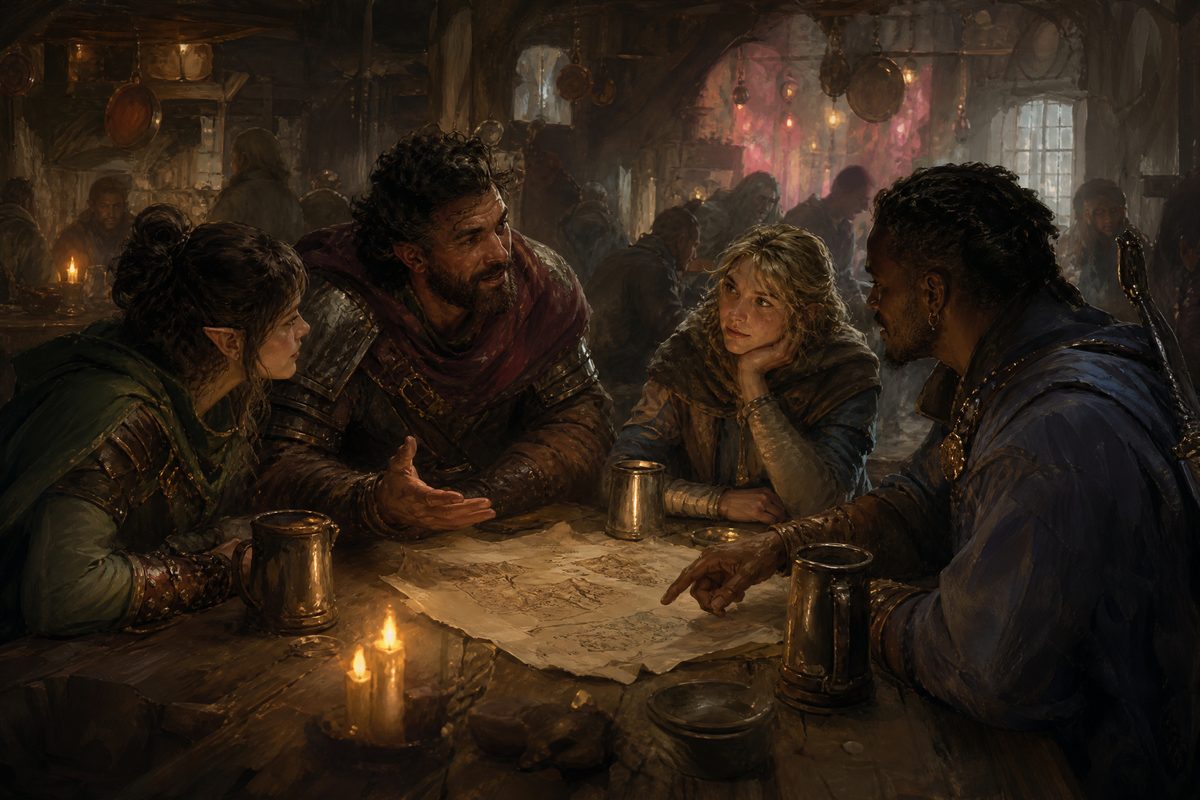
Most party games solve disagreement. The companions bicker for a while, you pick a side, an approval meter moves, and the matter is closed. The disagreement is a delivery mechanism for a choice, and once the choice is made it evaporates.
This game does not do that. The four of them sit down over a map and argue about which way to go, and at the end of the scene they are still arguing, and then you walk out of the tavern and the game lets you go whichever way you like without comment. Nobody's approval changes. Nobody references it later. It recurs, in six variations, across fifty-two hours.
The four positions
I remembered all four positions before opening my notes, and I had them right. The one who wants the coast road wants it because it is slow and she is not in a hurry to arrive. The one who wants the pass wants it because it is dangerous and he has a reputation to maintain that everyone else finds tedious. The third does not want to go at all and says so every time without ever refusing to come. The fourth has no route preference and spends every version of the scene trying to get the other three to stop.
Those are not plot positions. They are temperaments, restated in a new context every few hours, and they are why the names stuck.
| Companion | Position | Recalled at 12 months |
|---|---|---|
| The unhurried one | Coast road, because it is slow | Name, seat, reasoning |
| The reputation | The pass, because it is dangerous | Name, seat, reasoning |
| The reluctant one | Do not go, but comes anyway | Name, seat, reasoning |
| The peacemaker | No preference, wants quiet | Name, seat, reasoning |
| The errand itself | — | Nothing |
Why an unresolved argument is stickier
A resolved argument becomes a fact. Once the party has decided on the pass, the disagreement is history and the characters revert to their functions. What you retain is the outcome, and outcomes are cheap to store.
An argument that never resolves stays live. Every time the scene recurs, the same four temperaments collide again in a new setting, and each recurrence reinforces rather than replaces the last. It behaves, in memory, exactly like the habits described in essay one — repetition without progression.
The game never asked me to settle it, so I never filed it as settled, so it never stopped being present.
The cost of refusing to resolve
There is a real price. Because the argument has no mechanical consequence, several hours of good writing does nothing that a systems-minded player can point at. My notes from the time contain complaints about exactly this: "table scene again, no choice offered, unclear why this exists."
I was wrong, but not unreasonable. A player looking for agency in a party game will read a consequence-free argument as filler, and a lot of players will skip it on the second occurrence. The game accepts that cost in exchange for something it can only get by refusing to pay off: four characters who are still arguing in my head a year after I stopped playing.
What the plot lost
It is worth stating plainly how much went missing. I cannot tell you what the party was travelling towards, who commissioned it, what was at stake, or whether we succeeded. My notes say the objective is stated clearly and repeatedly. I have no memory of it whatsoever.
What I have instead is a seating arrangement, four temperaments, and the specific tone of voice in which the reluctant one says he is coming anyway. If that is a failure of the game, it is a failure I would take over most of this volume's successes.
The exception this makes to the volume
Everywhere else in volume four the pattern is that dialogue does not survive. This essay is the exception, and I have thought about why.
The dialogue here is not carrying information. Nobody explains anything, nobody advances anything, and there is nothing to retain except who these people are. Stripped of plot function, the conversation behaves like behaviour: repeated, purposeless, characteristic. It survives on the same terms as the pause on the ridge, which suggests the distinction this notebook has been drawing is not really speech against action, but function against habit.
That is a better formulation and I intend to use it going forward. Volume five will test it directly.