
Animal companions in games are usually instruments. They find things, they hold enemies, they carry the overflow from your bags, they mark points of interest on the map. Their affection is a wrapper around a utility, and when the utility stops being relevant the affection goes with it.
This one is not connected to anything. It follows you, it lies down when you stop, and it occasionally gets in your way. That is the complete feature list.
The idle threshold
The behaviour is governed, as far as any of us could tell, by a timer. Stand still for something in the region of four seconds and the animal closes the distance and settles, usually with its head across your foot if the ground is level.
Four seconds is a very deliberate number. It is longer than the pause you make while turning to look at something, and shorter than the pause you make while thinking about where to go. It fires almost exclusively when you have genuinely stopped, which means it never feels mistimed, which is the whole trick.
| Situation | Player pause | Animal settles |
|---|---|---|
| Turning to check a corner | 1–2 seconds | No |
| Reading a signpost | 3–5 seconds | Sometimes |
| Deciding a route | 6+ seconds | Yes |
| Standing at a view | 10+ seconds | Yes, and stays |
The ferry
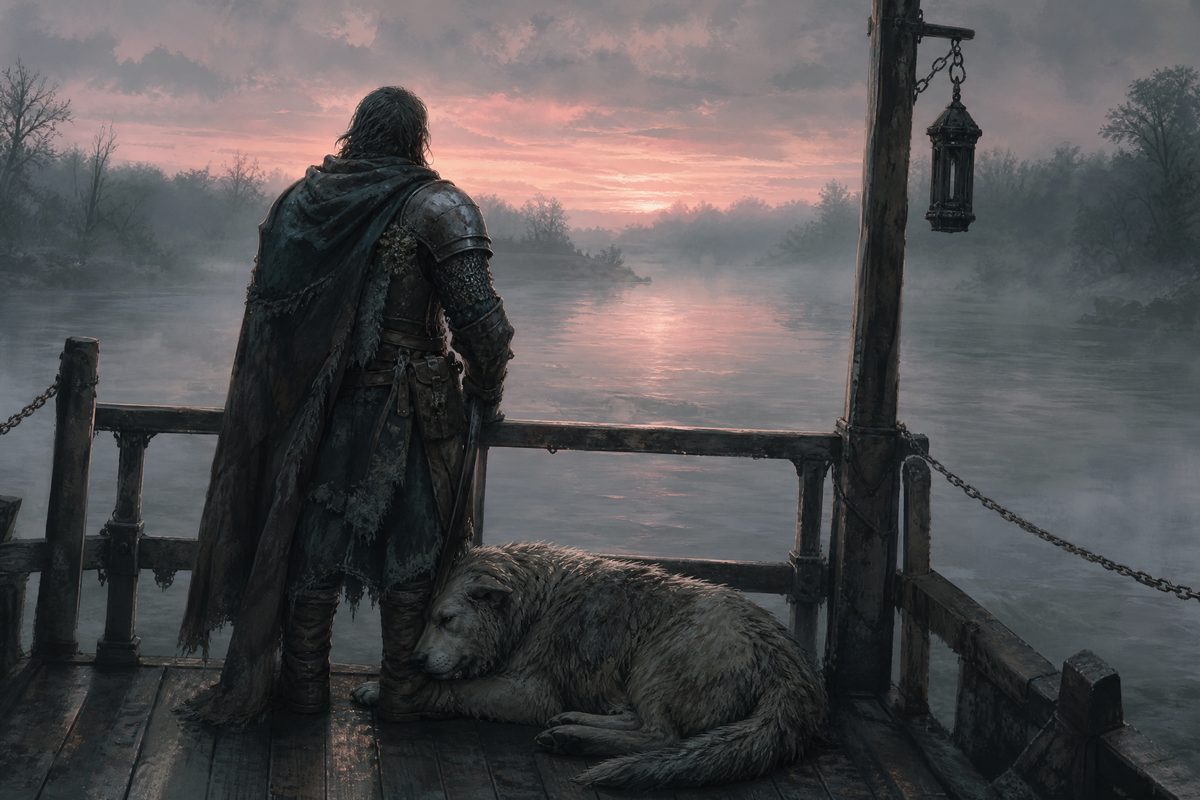
Everyone remembers the ferry. It is a slow crossing, a couple of minutes of no input, dawn on the water, and the animal is asleep on your boot before the far bank is visible.
Nothing happens on the ferry. There is no ambush, no conversation, no cutscene. It is a loading corridor dressed as a river. But because the crossing enforces a long pause, it guarantees the idle behaviour fires and holds, and it turns a technical necessity into the most reproduced screenshot in the game.
The game's most affecting moment is a loading transition with a four-second timer running underneath it.
Getting in the way as a feature
The second most-remembered behaviour is obstruction. The animal lies across doorways. It settles in the exact spot you were about to step. In one narrow stair it is physically possible to be blocked by it for several seconds while it works out where to go.
In a game where the animal had a job, this would be a bug report. Because it has no job, the obstruction reads as the sole cost of its company, and paying a small recurring cost for something you value is a very efficient way to make you notice that you value it.
This is the same argument as the refused stair in essay three, arrived at from the opposite direction. There, a limitation was read as fear. Here, an obstruction is read as presence. In both cases the friction is doing the emotional work.
Why two of us finished the game
I should be clear that the game around this animal is not very good. The combat is thin, the map is padded, and the story is a series of errands with a competent voice cast attached. Two of the three of us finished it. Both of us, independently, wrote a version of the same sentence in our notes: kept going because of the dog.
The third reader stopped at about hour eleven and, twelve months later, still recalled the animal in full. That is worth recording: full recall from a player who abandoned the game, of a companion with no mechanical function, in a title they otherwise describe as forgettable.
What it does not have
- No commands. You cannot call it, send it, or stay it.
- No death state. It cannot be hurt and cannot be lost.
- No progression. Nothing about it changes across twenty-nine hours.
- No dialogue about it. No character ever mentions it aloud.
- No achievement attached to it, anywhere.
That last absence matters more than it sounds. An achievement would have told me that the animal was content rather than company, and I would have started treating it as a checklist item. Left unrewarded, it stayed a thing I chose to notice.
The finding
Volume four's central claim — that habit outlives function — has its cleanest illustration here, because the function is precisely zero. There is nothing to remember about this companion except behaviour, and the behaviour is remembered in full by three readers a year on, including one who did not finish.
Set that against the party of six in the game described at the end of the index: fully voiced, mechanically integrated, extensively written, and not one name retained. The comparison is unkind but it is the reason this notebook exists.