
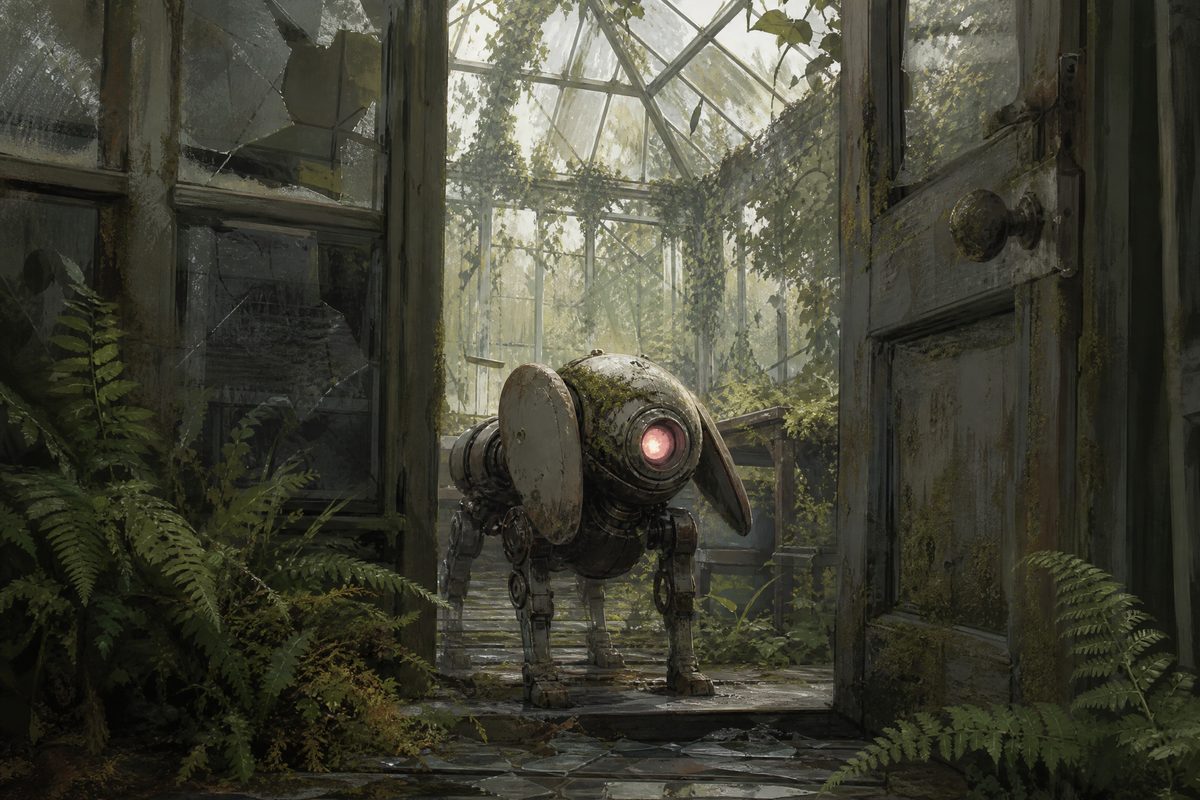
The game never names it. There is no introduction scene, no explanation of where it came from, and no mechanic that depends on it. It is simply present from about the second hour onwards, walking a few metres behind you through a flooded botanical institute, and it does not leave.
All three of us gave it a name. All three names were different, all three were remembered exactly a year later, and none of them came from the game.
Its whole vocabulary
The machine communicates through four channels, none of them linguistic. The colour of the lens, which shifts across a narrow range. The distance it chooses to keep, which varies with the space. Its posture when stationary, standing or settled. And a low mechanical sound on a loop that changes pitch slightly when it is close to something it recognises.
That is all. From those four dials, over twenty-two hours, it produced the impression of a personality so specific that I can tell you what it would have done in rooms the game does not contain.
| Channel | Range | What we read from it |
|---|---|---|
| Lens colour | Rose to amber | Attention, unease near water |
| Follow distance | 1.5 to 6 metres | Confidence in the space |
| Posture | Standing or settled | Whether the stop is temporary |
| Loop pitch | Narrow | Recognition of a place |
The doorway
The behaviour everyone remembers is the doorway. In corridors it follows at about two metres. At a threshold it stops, and it waits until you are fully through and a step beyond before it crosses.
The engineering reason is almost certainly navigational — narrow apertures are where a follower is most likely to collide with you or jam. Any competent implementation avoids them. But the effect of that avoidance, repeated across hundreds of doorways in a game about entering rooms you are not sure about, is deference. It reads as a thing that will not go first, and after twenty-two hours that reading is unshakeable.
A collision-avoidance rule became, through repetition alone, a character trait none of us could stop seeing.
The stair it will not use
There is a spiral service stair in the third district that the machine refuses. It arrives at the bottom, sits, and waits. Go up, do what you need to do, come down, and it is exactly where you left it.
I am confident this is a navmesh failure. The geometry is tight and the pitch is severe and the pathfinding gives up. It is, in the plainest engineering terms, a bug.
All three of us remembered it. Two of us described it, unprompted, in language about fear. One of us went back to that district late in the game specifically to check whether the machine would follow this time. It would not. That player wrote in their notes: "still won't, fine, I'll go alone."
What this does to the argument
Across four volumes we have been circling a claim that we have been reluctant to state plainly, because it sounds like a provocation. This essay is where we state it.
Dialogue is not what makes a companion memorable. It is what makes a companion legible in the moment and forgettable afterwards. Behaviour is what persists. A companion built from four non-verbal dials outperformed, at twelve months, an entire cast of fully voiced characters in a game three times its length — the one described in the closing section of our index page, where a party of six left no names behind at all.
The uncomfortable corollary is that some of what we remember most fondly is not authored. The doorway is a solved technical problem. The stair is a defect. We built a personality out of a follow system's limitations, and a year later that personality is more durable than any script in this volume.
Against reading too much into it
It would be easy to conclude that studios should cut dialogue and rely on emergent charm. That conclusion does not follow, and I want to be careful here.
This machine works because the game around it is quiet. Twenty-two hours of flooded glasshouses and empty administrative buildings with almost no other characters. In that silence, four dials are an enormous amount of information. Put the same machine in a game with a talking party of six and it becomes furniture.
What the essay claims is narrower: when a companion's behaviour is consistent, frequent, and slightly imperfect, players will do the authoring themselves, and what they author is what survives. The animal in essay five is the same finding in fur rather than metal.