
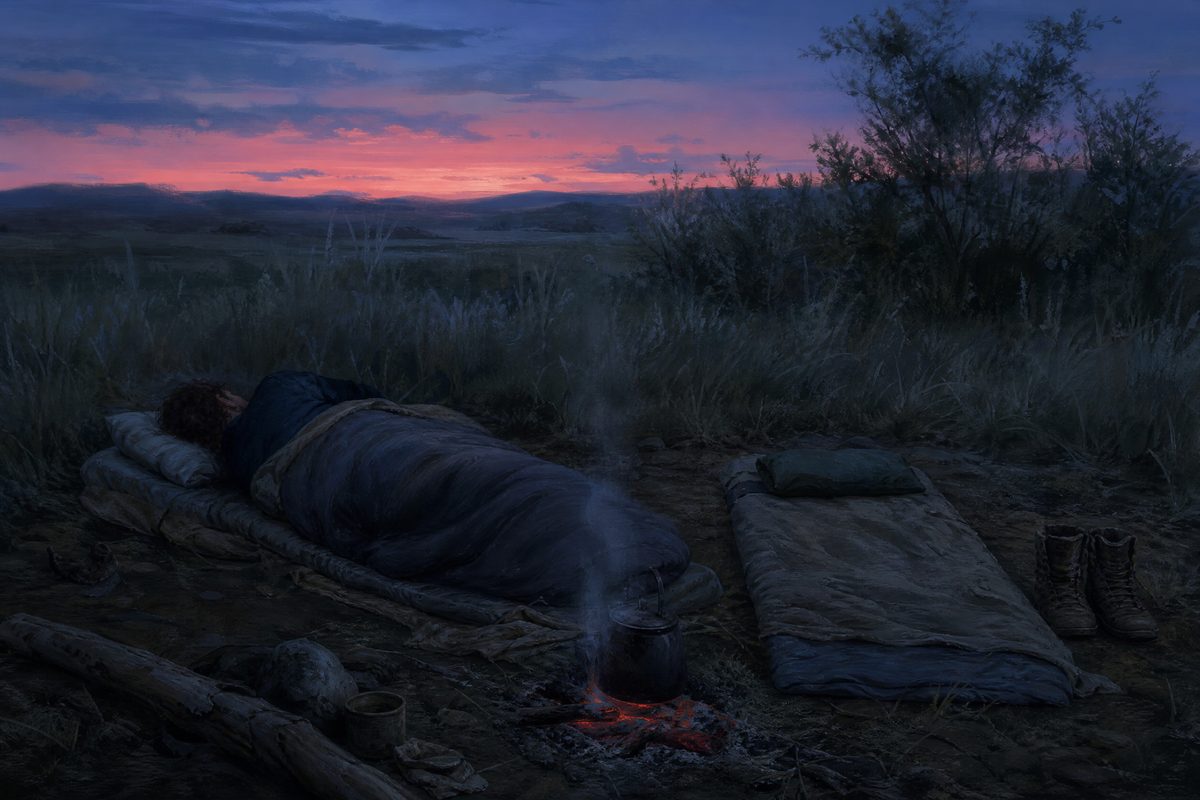
The camp screen in this game is a diorama rather than a menu. You place a fire, you place a shelter, and the game arranges the rest according to what you are carrying. From the first camp onwards it laid out two bedrolls, positioned the kettle between them, and set a pair of boots neatly beside the bed I never used.
I spent a long time thinking this was a bug, or at best an artefact — a diorama authored for a two-person party in a game that had not yet given me a second person. Survival games are held together with tape. You learn not to read meaning into every seam.
The instinct to explain it away
My notes from hour four say, and I am quoting myself with some embarrassment, "camp layout assumes companion, probably cut content." I had already decided. Every subsequent camp confirmed a theory I had formed in ten seconds and never revisited, which is how most of us play most games.
The kettle poured two cups. I noted that too, in the same dismissive register. Placeholder. Asset reuse. Move on.
Thirty hours of evidence that I filed as sloppiness, because sloppiness was the cheaper explanation.
What actually happened
Around hour thirty the game gives you a second traveller. There is no ceremony to it. She arrives, she is competent, she carries her own supplies, and at the next camp she lies down in the bedroll that has been laid out since the first night and pulls the boots over to her side of the fire.
Nothing is said. No character remarks on it. There is no achievement, no journal entry, no swell of music. The diorama simply resolves, and thirty hours of what I had classified as a production error become thirty hours of a game quietly holding a place for someone.
| Detail | My reading at hour 4 | Reading after hour 30 |
|---|---|---|
| Second bedroll | Cut content | A place kept |
| Kettle pours two | Asset reuse | A habit, not an error |
| Boots by the empty bed | Decorative clutter | Someone specific's boots |
| Shelter sized for two | Fixed prop | Deliberate |
Why this survived and the crafting did not
This game has an elaborate production chain. Ore into ingots, hide into cord, cord into lines, lines into a shelter that resists a particular kind of weather. I invested many hours in it and I retained almost none of it. Ask me the recipe for anything and I will invent something plausible.
What survived is a piece of furniture that did nothing for thirty hours. Not because it was dramatic, but because I had looked at it several hundred times, formed a judgement about it, and then been shown that my judgement was wrong. The memory is not really of the bedroll. It is of being corrected.
That is the mechanism this essay exists to point at, and it is close kin to the finding in our lead essay. Repetition in the background beats presentation in the foreground. But this game adds something the ridge path does not: it lets you be wrong about the repetition first, and then quietly proves you wrong without a word.
The cost of doing it this way
I want to be honest that this is a bad idea from most commercial angles. Thirty hours is far past the point at which most players stop. A very large majority of people who bought this game will never have reached the camp where the second bedroll is filled. For them, the layout is exactly what I thought it was: a seam.
There is no defending that as a design strategy at scale. What I can say is that for the minority who got there, the payoff is the only thing from the game that is still standing a year later, and it cost the studio approximately nothing to build. One prop, one animation, and the discipline not to draw attention to either.
The second companion, briefly
Her name I remembered correctly. Her habit — she reties the boots before sleeping, every camp, regardless of weather — I remembered correctly. What she says, at any point, in any conversation, I could not reproduce a single line of.
Two companions in this game, both recalled in full, and in neither case is any dialogue part of what I retained. That is now a pattern across four volumes rather than an anecdote, and it is the reason the next essay concerns a companion who never speaks at all.